
Machine Residue
Curatorial Essay
Machine Residue intertwines the voices of diaspora artists living in Melbourne's west about war, loss and survival. It asks: what remains under the systemic violence, dehumanising regimes and their aftermath?
Some works emerge directly from personal encounters with military governments and displacement, while others are shaped by the intergenerational impact of such experiences. There is no common trajectory in the journey of endurance. The identity of former refugees in Australia, however, is often flattened to a simple narrative. Social boundaries and marginalisation intentionally hinder understanding and sustain alienation. And when confronted with crises of ‘others’, a familiar refrain arises: why should we care?
The exhibition instead excerpts fragments of sentimental voices from artists as humans, not categories. Amid political oppression and human rights violations at the global level, there is a need to allow reflections beyond borders and boundaries, nations and peoples. For a moment, we may reconsider how nationalism as political ideology impacts our communities locally. After all, the sense of nation itself is grounded in imagination and the construction of myths.[1] In contrast, subjectivity built from experiences is fundamental to examining aspects of truth. The subjective encounter acts toward a release from empirical constraints and from the weight of external, imposed orders.[2] Therefore, artistic expressions carry the essence of human societies. By suspending time and geography, Machine Residue evokes empathy and emotions while disregarding dominant framework.
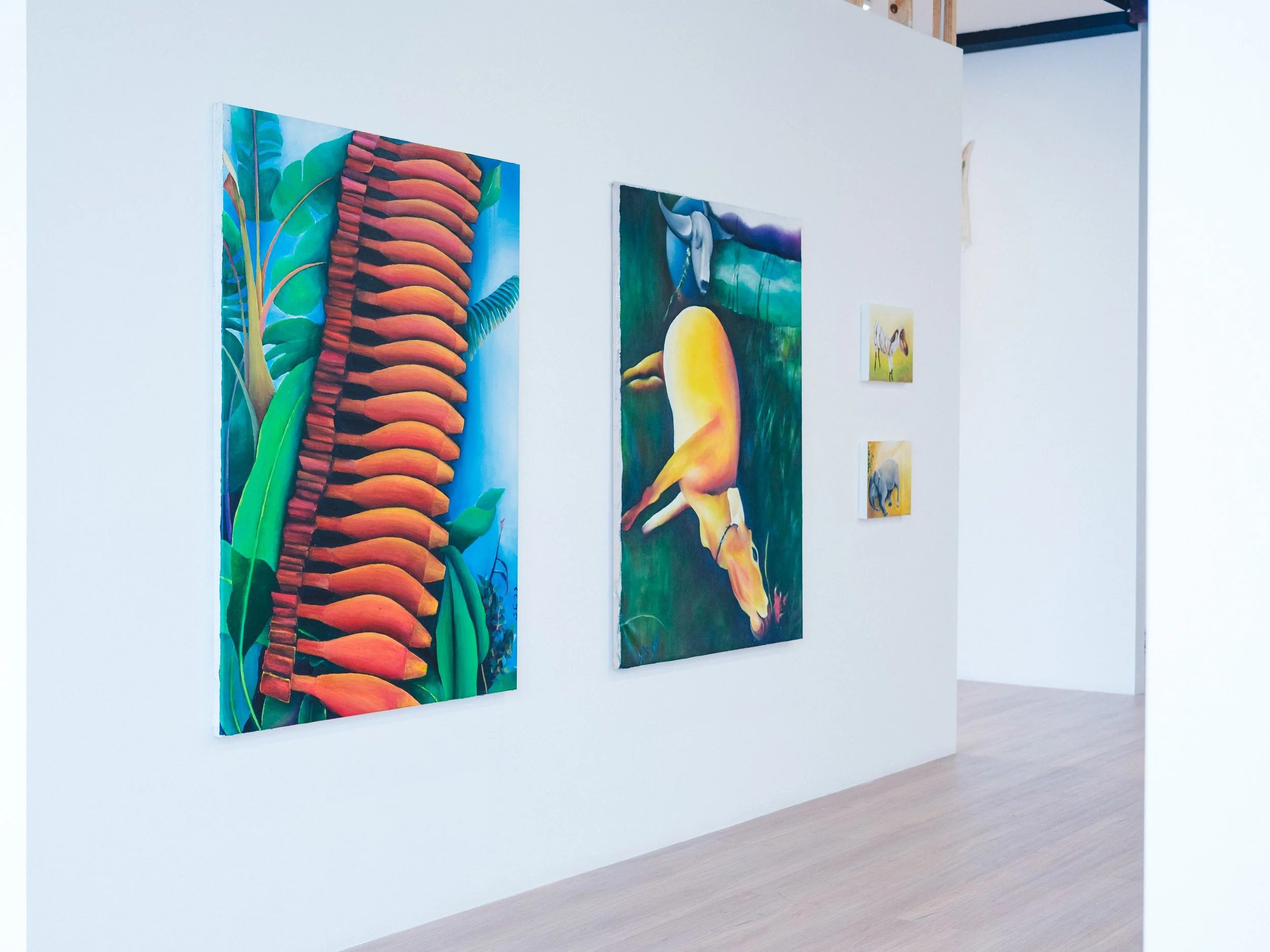
Image: bAg, installation views of 60mm Mortar Round, Peace and War, The Wound of The Goat, ဆင်သေကိုဆိတ်ရေနှင့်ဖုံး. acrylic and oil on canvas, gouache and soft pastel. Trocadero Projects. Photographed by publista.
Artists bAg and Ma Ei have lived experiences of resisting authoritarian violence imposed by the 2021 Myanmar coup d'état. Since Myanma’s independence from the British rule in 1947, the military state was maintained, dictatorship was established and violence permeated.[3] At the heart of the paintings by bAg is a disturbing juxtaposition of war and peace. The goat can be read as human mind (the two are pronounced the same in the Burmese language), while cattle as a significant symbol of agriculture and people’s life in the country. The wounded animals and devastated natural environment signify the destruction of humanity, literally and metaphorically.
Ma Ei’s Where Is a Place for Me to Sleep in Peace is a body of photographs tracing her personal journey and deep concern for her suffering community. From confronting the military coup in Myanmar to living in exile in Thailand, the work articulates moments when tomorrow is misty and yesterday is haunting. The sequence concludes at the Brighton Beach in Melbourne. But what was constructed in this image is still unease, accentuated by its melancholic tones. Physical separation from violence does not mean peace. Ma Ei continues to be troubled by the struggles of other vulnerable living beings, particularly marine and aerial animals threatened by plastic pollution.
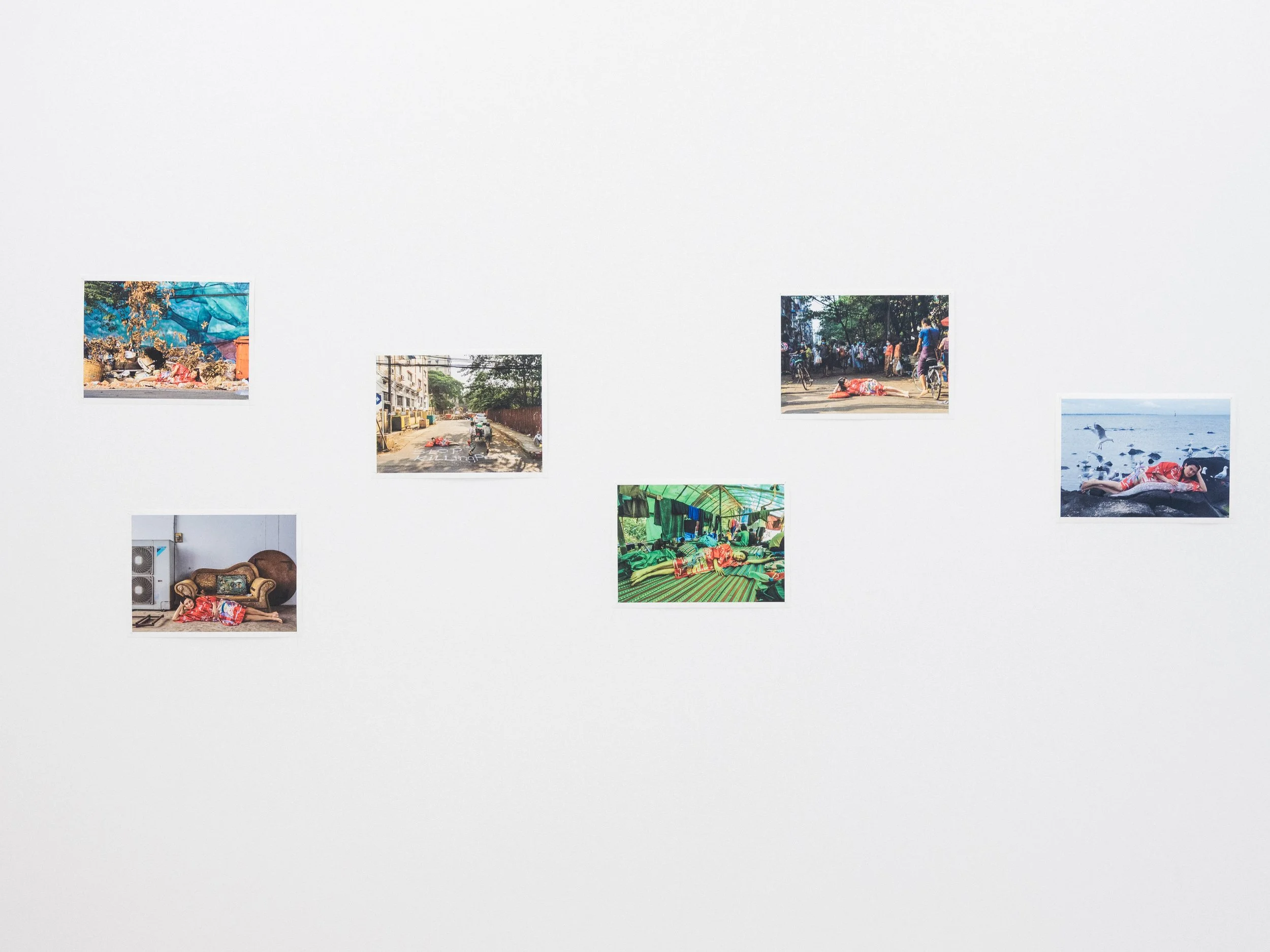
Image: Ma Ei, installation views of Where is A Place for Me to Sleep in Peace? 2021-2023, ink pigment on paper. Trocadero Projects. Photographed by publista.
The Other Stories by Ammar Yonis is a series of short fictions around difficult journeys to new places, evoking a sense of uncertainty and strangeness that accompany them. They are inspired by first-hand experiences of the artist’s family members. Often, readers may find distinct moments of unexpected encounters, nerve-racking decisions, or light-hearted clashes in unfamiliar settings. By weaving memory and fiction, the stories become a means for stirring reflections on dislocation and its lifelong impact on the consciousness and subconsciousness.
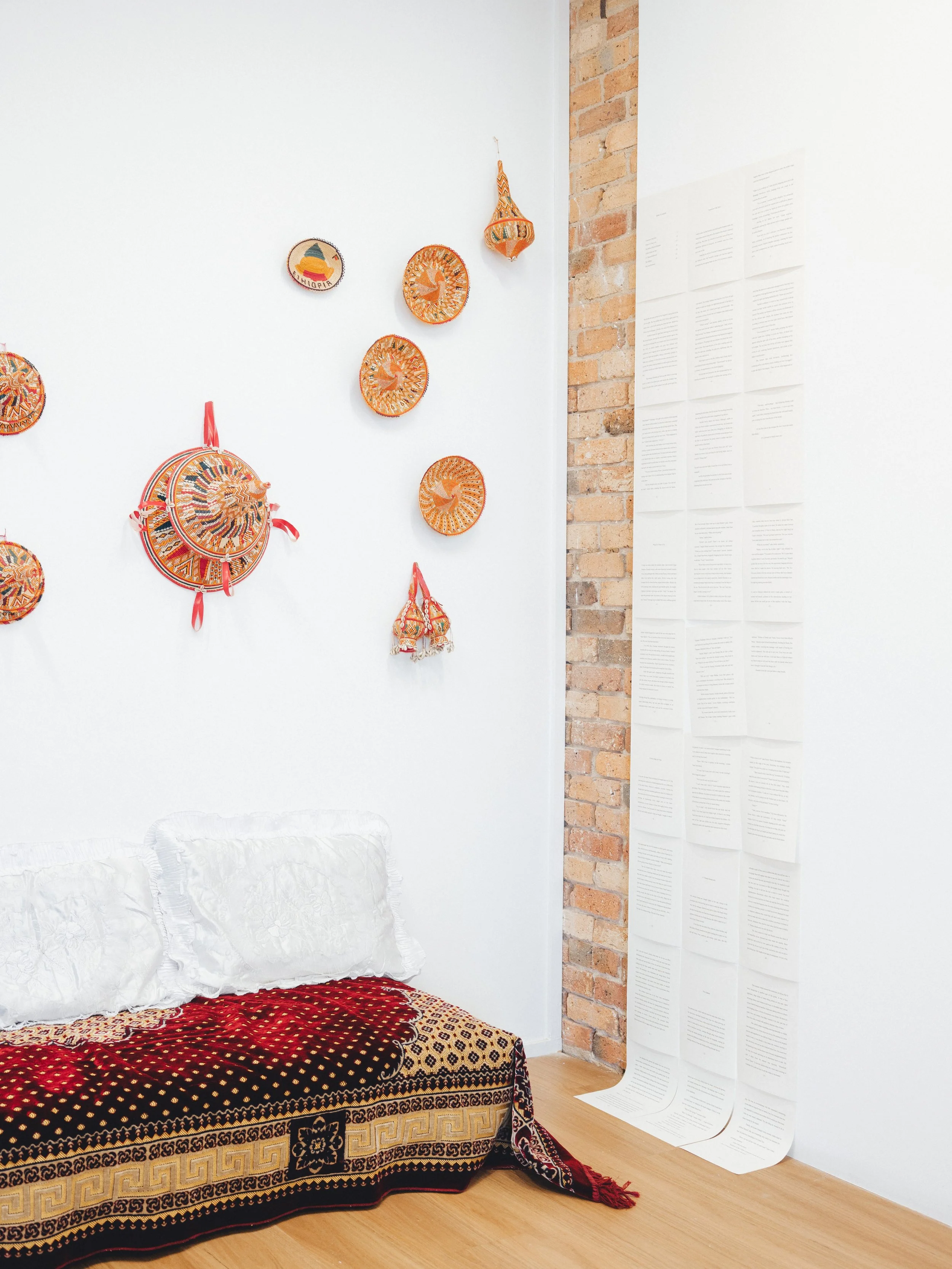
Image: Ammar Yonis, installation views of The Other Stories, 2024-2025, ink pigment on paper, book prints, paste-ups and Harari style home installation for reading. Trocadero Projects. Photographed by publista.
In Textiles in Gaza, Safa El Samad explores loss and survival with the device of architectural drawing and machine embroidery. Gaza has long been a centre for textiles. While cultural identity and human lives have faced dismantlement by Israeli occupation, the construction of makeshift shelter highlights the resilience of the displaced Palestinians. The artist’s use of modern embroidery technique functions as a contemporary lens on this ongoing resistance, echoing the historical significance of textiles in the pictorial narrative, as well as the collective endurance of people in Gaza.
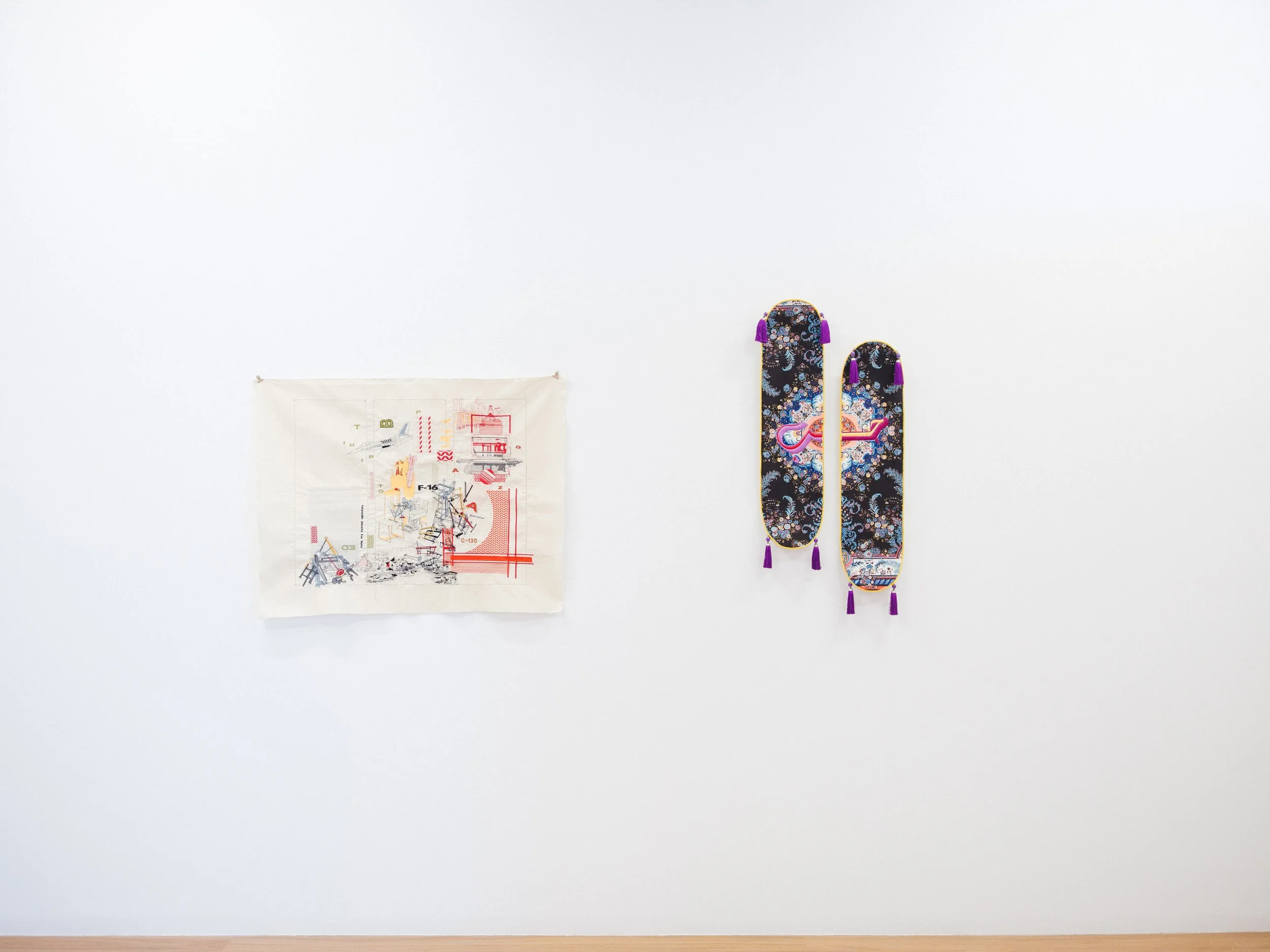
Image: Safa El Samad, installation views of Textiles in Gaza (left), Love (right), 2025, embroidery on fabric. Trocadero Projects. Photographed by publista.
The curatorial methodology features cross-cultural dialogues between the works, transcending time, context and ideals. Distress in Where Is a Place for Me to Sleep in Peace can be viewed as a concretised emotion of the ominous representation in 60mm Mortar Rounds. In response to such suffering and trauma, Love presents a manifesto of care for the displaced, declaring its advocacy for humanity. These experiences can be transmitted intergenerationally, becoming memories of someone else in this community and being reconstructed into fictional moments like what one can see in The Other Stories.
Why is it important to create and witness these dialogues? In Michel Foucault’s genealogy theory, truth in history can be traced by the in-between interpretations instead of dominant narratives.[4] When such in-between interpretations are gathered into a cohesive flow, as one can experience in this exhibition, the authority of hegemonic frameworks reinforced by mass media, institutional education, government strategies, begins to wobble. It is important to acknowledge that contextual factors are essential for understanding how struggles and pain unfold, as each experience is unique and follows its own trajectory. Yet the act of weaving together fragments at risk of being forgotten, across different contexts, does not conflict with the need to respect and learn from each circumstance. This curatorial methodology arises from an urge to expand solidarity. The interwovenness of personal accounts and how humans deeply feel for each other in these works, can effectively decipher the linearity of hegemony.
Gathering temporalities from diverse perspectives can be powerful. Machine Residue does not seek one single narrative, but rather an assemblage of lived and imagined experiences that speak to one another. In their coexistence, these works disrupt reductive representations, and reveal the complex residues of war, migration, and survival that continue to shape our shared humanity.
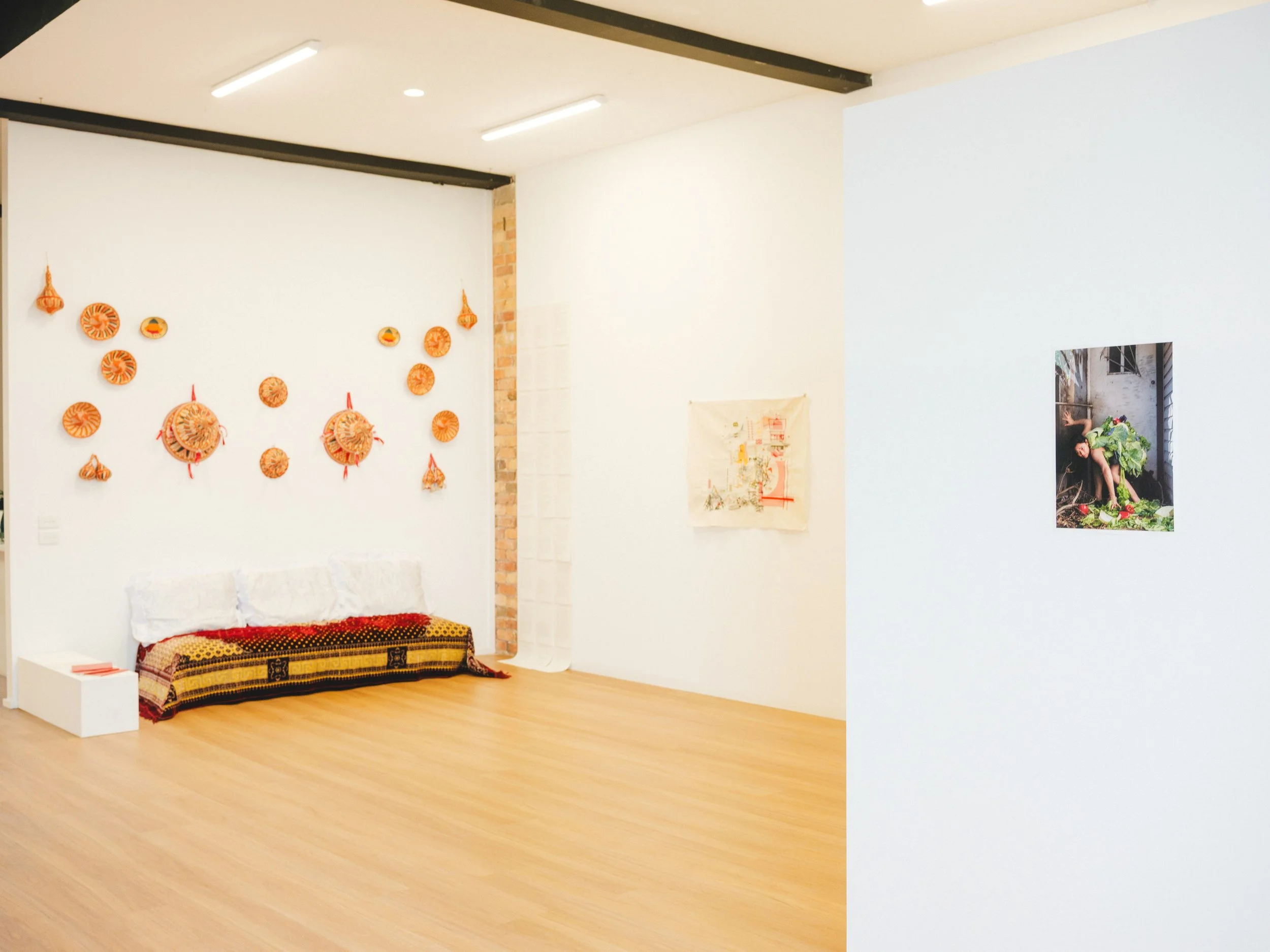
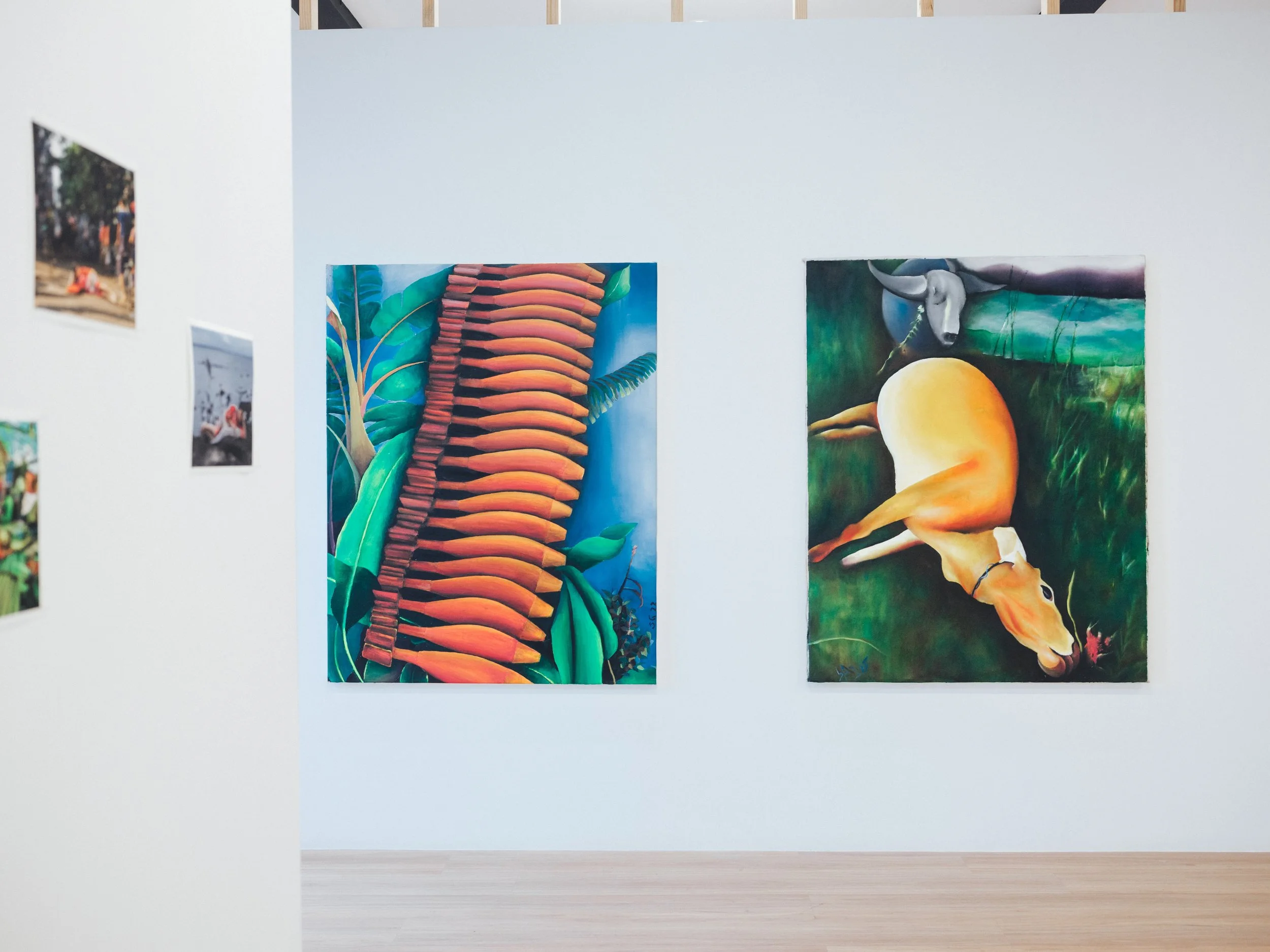
Image: Installations views of Machine Residue, Trocadero Projects. Photographed by publista.
References:
[1] David Archard, “Myths, Lies and Historical Truth: a Defence of Nationalism.” Political Studies, XLIII (1995), 481.
[2] Theodor Adornom Aesthetic Theory. ed. Gretel Adorno and Rolf Tiedemann. Translated by Robert Hullot-Kentor. Minneapolis. (University of Minnesota Press, 1997), 198-203.
[3] Ewan Cameron, “The State of Myanmar.” History Today, no.5 (May 2020) 70: 92.
[4] Michel Foucault. Language, Counter-Memory, Practice: Selected Essays and Interviews, ed. Donald F. Bouchard. (Cornell University Press, 1977), 152.
